

Free FE Civil practice exam
This runs the full paper. Read these five things — they are the parts people meet for the first time on exam day.
Not ready for five hours? Start with the first 10 questions of the paper. No account, and your answers carry over if you continue.
Try 10 questions free- 1110 questions, 5 hours 20 minutes.
That is 2.9 minutes per question. The clock runs on the server, so closing the tab does not stop it.
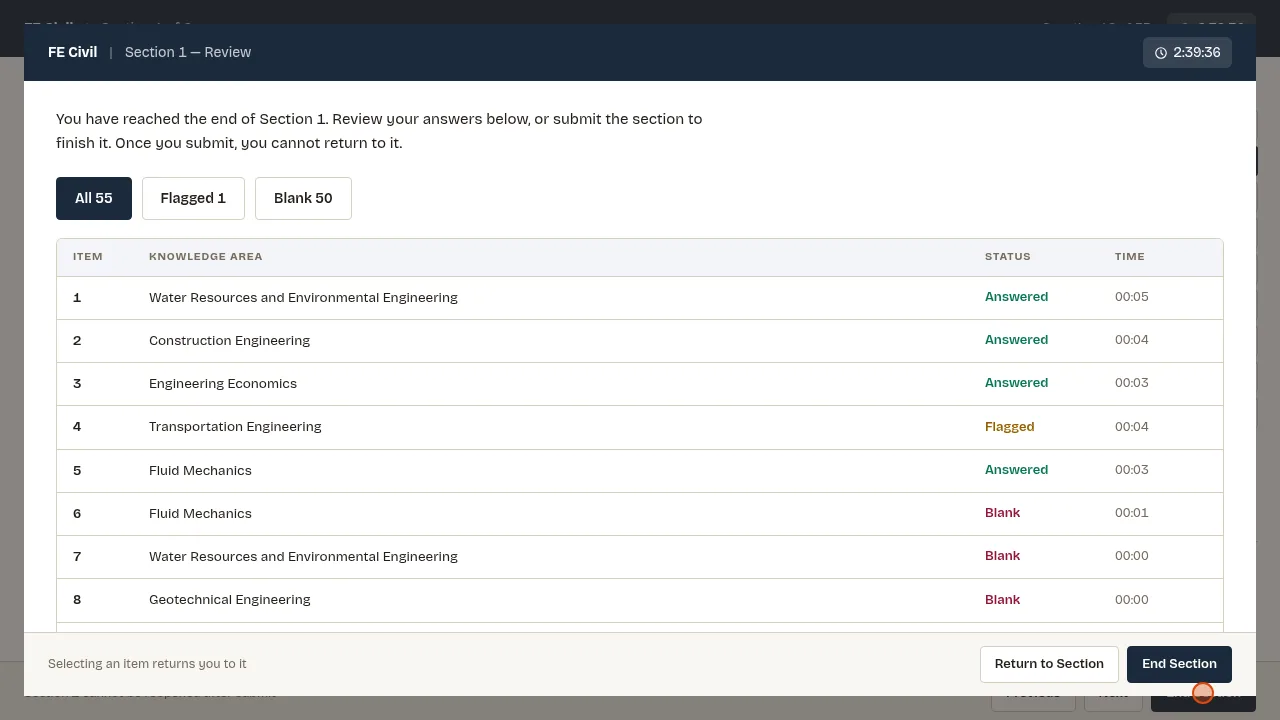
- 2Two sections. Section 1 cannot be reopened.
Once you submit it, it is gone. This is the trap that costs people the most marks.
- 3A 25-minute scheduled break sits between them.
The clock genuinely pauses. Unused break time is forfeited, exactly as at the test centre.
- 4The only reference is the NCEES Handbook 10.6.
We do not host the handbook — use NCEES's own free download. Page citations on solutions are not built yet; when they are, they will be printed page numbers, not PDF viewer positions.
- 5You can close the tab and come back.
Answers, flags, strikethroughs and per-question timing are kept in your browser first and synced after, so a slow network never blocks an answer.
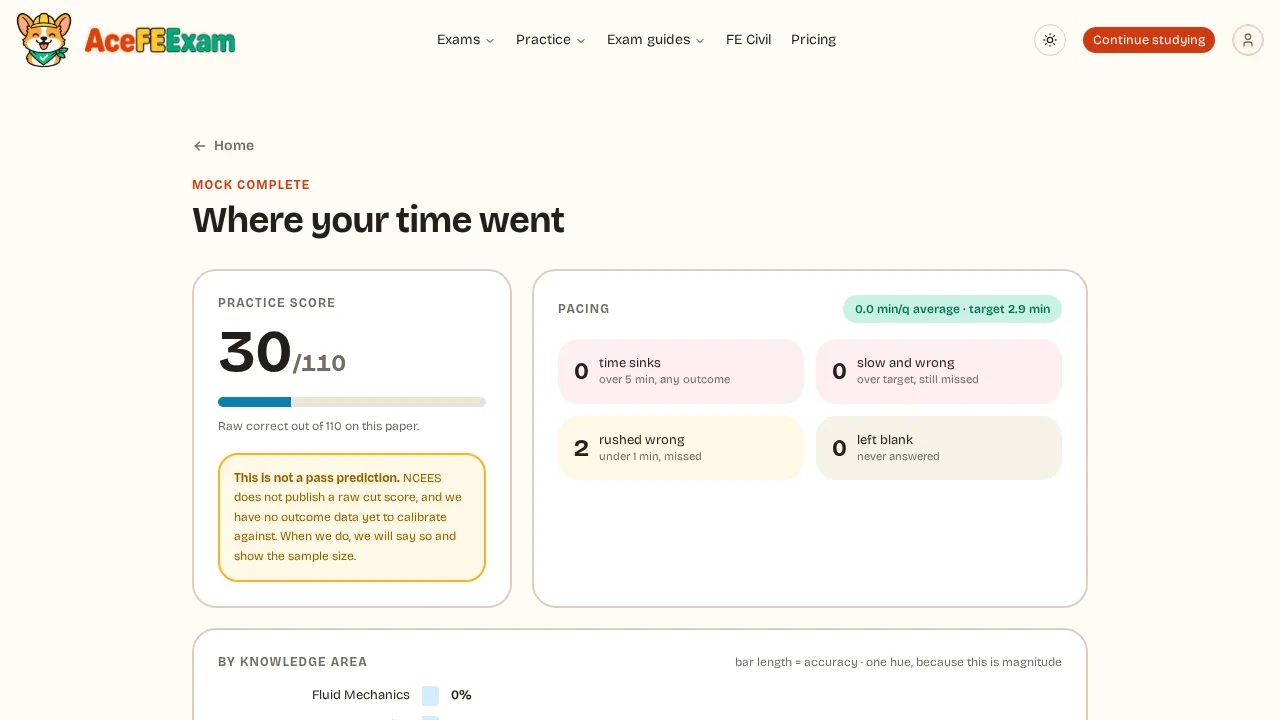
What the mock looks like
Choose your next study step
What you get in the free FE Civil mock
- A full 110-question FE Civil paper on the real clock: 5 h 20 min of exam time, two sections of 55, and the 25-minute scheduled break between them.
- The real exam’s one-way door: once Section 1 is submitted it cannot be reopened.
- Questions spread across all 14 NCEES knowledge areas, written to the FE Civil specification and the FE Reference Handbook 10.6.
- A worked solution for every question after you submit, with the reasoning behind the wrong choices.
- Free with an account: one full-length paper every 30 days. No card.
3 worked sample questions from the mock
The same style, length and difficulty as the paper. Pick an answer, then open the worked solution.
Question 1 of 3
A trapezoidal channel has a bottom width of 12 ft and side slopes of 2H:1V. Manning's roughness coefficient is 0.03 and the channel slope is 0.002 ft/ft. For uniform flow at a normal depth of 3.5 ft, the discharge is most nearly:
Trapezoidal channel with a bottom width of 12 ft, side slopes of 2 horizontal to 1 vertical, flowing at a normal depth of 3.5 ft. Show the answer and the reasoning
Why C
Given: b = 12 ft, side slopes 2H:1V, y = 3.5 ft, n = 0.03, S = 0.002 ft/ft. Relation: Q = (1.486/n) A R^(2/3) S^(1/2), with A = (b + zy)y, P = b + 2y sqrt(1 + z^2) and R = A/P. Substitute: A = 66.50 ft^2, P = 27.65 ft, R = 2.405 ft. Result: Q = 264.4 cfs. Check: the wetted perimeter excludes the free surface.
Why A is tempting
Counted the free surface in the wetted perimeter. Only the bed and the two side slopes are wetted.
Why B is tempting
Used the SI coefficient 1.0 instead of the USCS coefficient 1.486.
Why D is tempting
Measured each sloping side as zy, its horizontal run, rather than y sqrt(1 + z^2), its length along the slope.
Source FHWA HDS-4, Introduction to Highway Hydraulics — Section 2.3, Manning equation for open channels
Question 2 of 3
A normally consolidated clay layer 28 ft thick has Cc = 0.3 and an initial void ratio of 0.8. The initial effective stress at mid-depth is 2750 psf and a fill adds 500 psf. The primary consolidation settlement is most nearly:
Show the answer and the reasoning
Why C
Given: H = 28 ft = 336 in, Cc = 0.3, e0 = 0.8, sigma0' = 2750 psf, added 500 psf. Relation: Sc = Cc x H/(1 + e0) x log10((sigma0' + d_sigma)/sigma0'). Substitute: (0.3)(336)/(1 + 0.8) x log10(1.182). Result: Sc = 4.06 in.
Why A is tempting
Used the stress increment alone in the ratio. The final stress is the initial stress plus the increment.
Why B is tempting
Left the clay thickness in feet where inches were asked for.
Why D is tempting
Used a natural logarithm. The compression index is defined against a base-10 log of the stress ratio.
Source NAVFAC DM-7, Soil Mechanics and Foundations — DM-7.01 Chapter 5, consolidation
Question 3 of 3
A vehicle travels at 50 mph on a 4% downgrade. Using a perception-reaction time of 2.5 s and a deceleration rate of 11.2 ft/s^2, the stopping sight distance is most nearly:
Vehicle travelling at 50 miles per hour on a -4.0 percent grade; the stopping sight distance is the reaction distance plus the braking distance, and the grade helps or hinders the braking part only. Show the answer and the reasoning
Why C
Given: V = 50 mph, t = 2.5 s, a = 11.2 ft/s^2, G = -0.04 (negative downhill). Relation: SSD = 1.47Vt + V^2/(30(a/32.2 + G)). Substitute: reaction = 1.47(50)(2.5) = 183.8 ft; braking = 50^2/(30(0.3478 + -0.04)) = 270.7 ft. Result: SSD = 454.5 ft.
Why A is tempting
Gave the perception-reaction distance only, with no braking.
Why B is tempting
Used mph directly in the reaction term. The 1.47 converts mph to ft/s.
Why D is tempting
Double-counted the perception-reaction distance.
Source FHWA geometric design and pavement guidance — Stopping sight distance criteria
Free mock vs the NCEES FE practice exam
| AceFEExam free mock | NCEES interactive practice exam | |
|---|---|---|
| Questions | 110, the full paper | 50 per exam |
| Price | Free, one every 30 days | $50 per volume (FE Civil has Vol. 1 and Vol. 2) |
| Question source | Original questions written to the NCEES specification | Retired real NCEES exam items |
| Timing | Always the real clock: 5 h 20 min, 25-minute break | Optional timed mode |
| Solutions | Worked solution for every question after you submit | Solutions available to review |
| Results | Results by knowledge area | Correct/incorrect counts by knowledge area |
NCEES details from NCEES exam prep and NCEES’s launch announcement, checked 20 October 2026. The NCEES exams are the only practice built from real retired items, and worth buying for that; they are not a full-length timed paper.
Frequently asked questions
Is the AceFEExam FE Civil mock exam really free?
Yes. With a free account you can sit one full-length paper every 30 days, with worked solutions for every question after you submit. No card is needed.
How long is the free FE Civil mock?
110 questions in 5 h 20 min of exam time — the same as the real FE — split into two sections of 55 with a 25-minute scheduled break between them.
How is it different from the NCEES FE practice exam?
NCEES’s interactive practice exams are 50 questions, cost $50 per volume, and are built from retired real exam items. This mock is a full 110-question paper on the real clock, free, made of original questions written to the NCEES specification.
Which reference handbook does the mock use?
The NCEES FE Reference Handbook 10.6, the edition for exams from 1 July 2026. We do not host it: download your free copy from MyNCEES and keep it open, as you will use it on screen in the real exam.
More free practice: 84 FE Civil practice problems by area · the 14 FE Civil knowledge areas · how the FE is scored · searching the FE Reference Handbook