

What is the FE exam passing score?
Short answer
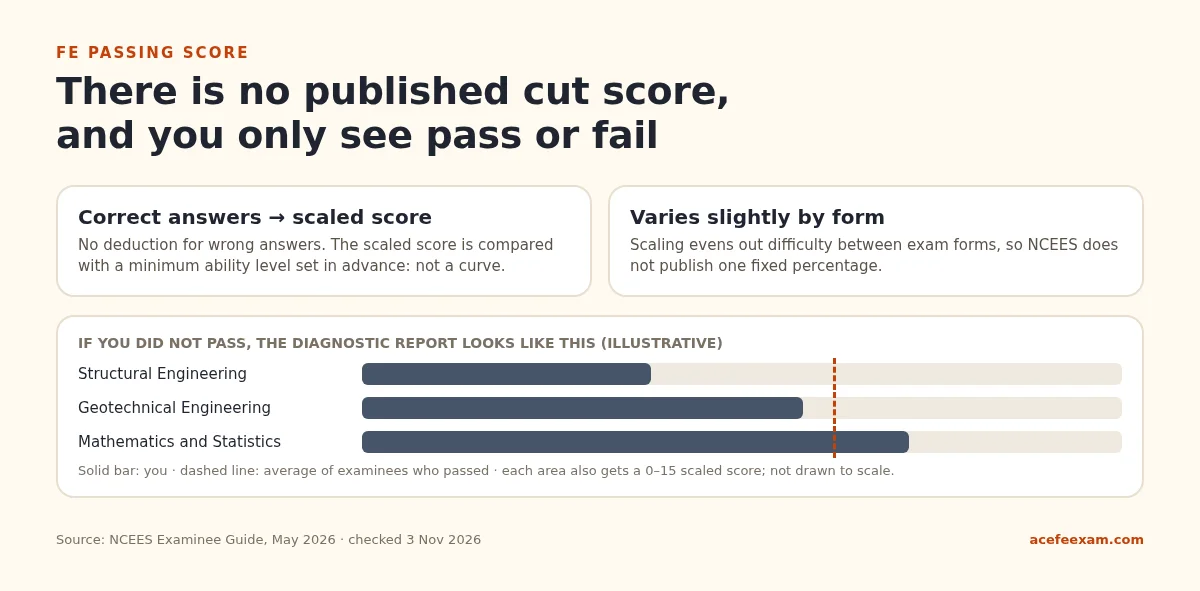
NCEES does not publish a passing score for the FE exam. Your result is based on the number of questions you answer correctly, with no deduction for wrong answers; that count is converted to a scaled score and compared with a minimum ability level set by NCEES. You receive only "pass" or "fail".
Checked against the sources below on October 20, 2026.
How the FE is scored, in NCEES’s words
- Results are based on the number of questions answered correctly. There is no penalty for a wrong answer, so never leave a question blank.
- The raw count is converted to a scaled score. Scaling evens out small differences in difficulty between exam forms, which is why NCEES says the passing score varies slightly from form to form and is not published.
- The scaled score is compared with a minimum ability level — a standard set in advance, not a curve. NCEES states there is no predetermined percentage of examinees who should pass or fail.
- First-time and repeat takers are graded to the same standard.
- Results are reported as pass or fail, typically within 7–10 business days. If you fail, you also get a diagnostic report by knowledge area.
Is it 70%? Is it 50%?
You will see figures like "about 50–60% correct" or "70%" on forums and prep sites. None of them comes from NCEES, and NCEES says the passing score cannot be worked out from the diagnostic report either. Treat any specific percentage as somebody’s estimate. The defensible statement is the one above: a fixed standard, a scaled score, and a result of pass or fail.
What you can measure instead
Pass rates are published. In January–June 2026, 66% of first-time FE Civil takers from accredited programs who tested within 12 months of graduating passed. Across all FE Civil takers in NCEES’s 2025 fiscal year, first-time takers passed at 61% and repeat takers at 32%.
What this means for how you practise
- Answer every question. With no deduction for wrong answers, a blank is always worth less than a guess.
- Practise on the clock. The exam is 110 questions in 5 hours 20 minutes of exam time — under three minutes each — so a target score on untimed practice tells you little.
- Weigh areas by size. Each knowledge area carries a range of questions in the specification; in FE Civil, Ethics carries 4–6 and Structural Engineering 10–15. Raising a heavy area moves your total further.
Keep reading
Frequently asked questions
What score do you need to pass the FE exam?
NCEES does not publish one. It converts the number of questions you answer correctly to a scaled score and compares it with a minimum ability level; the result is reported only as pass or fail.
Is the FE exam graded on a curve?
No. NCEES says each exam is scored against a fixed standard with no predetermined percentage of examinees who should pass or fail, and first-time and repeat takers are graded to the same standard.
Are wrong answers penalised on the FE?
No. NCEES bases results on the number of questions answered correctly, with no deductions for incorrect answers.
Can I find my score from the diagnostic report?
No. The report gives each knowledge area a scaled score from 0 to 15 and a bar against passing examinees. NCEES says the number of questions answered correctly cannot be determined from it.
Check where you stand, free
The quick diagnostic is eight FE Civil questions in about ten minutes, with no account. The free mock is a full 110-question, 5 hour 20 minute FE Civil paper with a worked solution for every question.